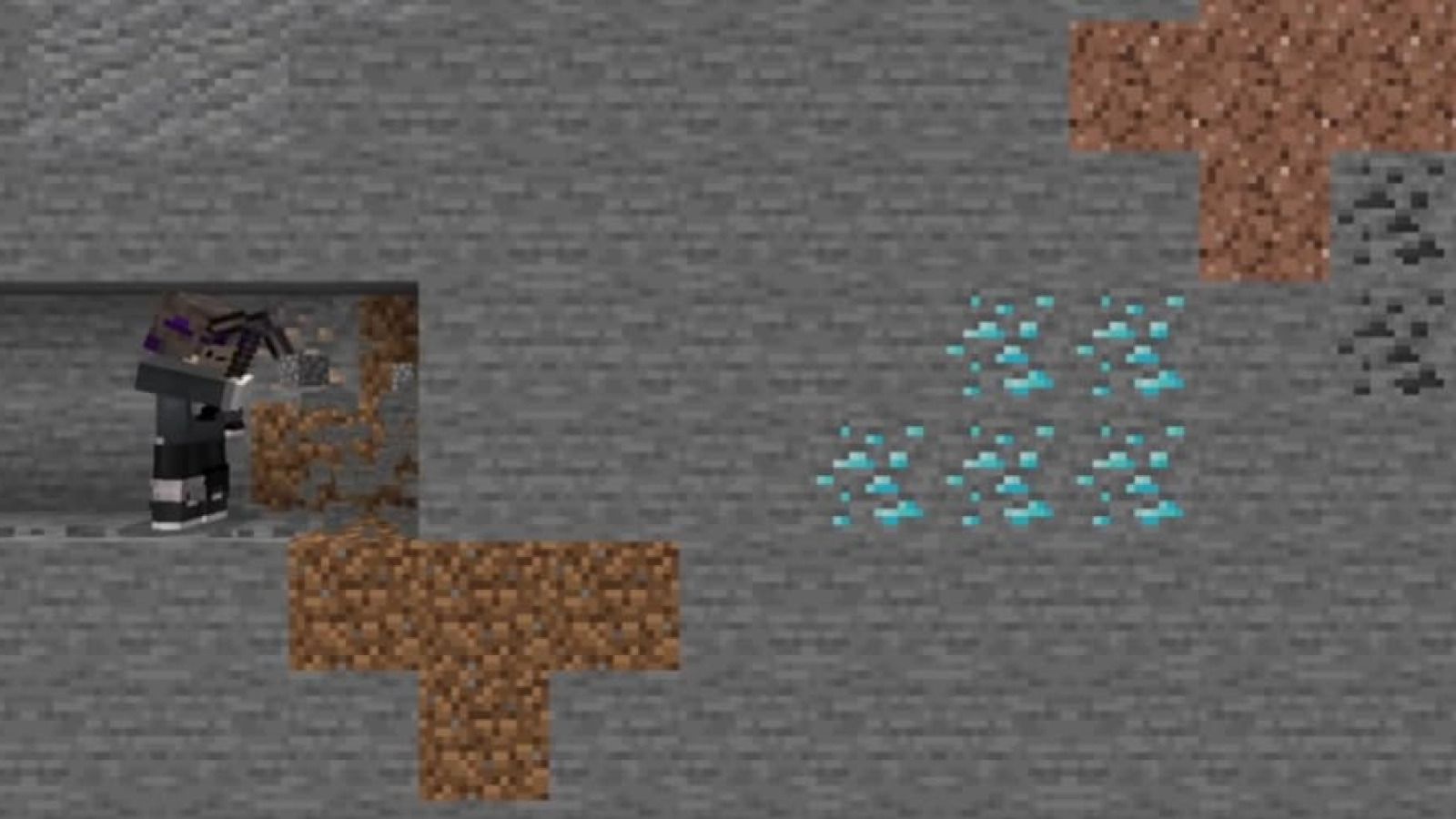
Diamond hunting changed when Minecraft expanded the Overworld below Y=0. The old advice to settle around Y=11 belongs to an earlier terrain system. Mojang’s current ore distribution starts diamond generation below Y=16 and increases it as you descend, while reducing the amount exposed directly to air. The practical result is simple: go deep, but choose a floor that leaves room to work above the bedrock layer.
Choose a useful depth, not merely the lowest number
Y=-58 is a sensible working level for a two-block-high tunnel. It places the floor near the bottom of the world without forcing every step through the densest bedrock. Y=-59 can also work, but irregular bedrock becomes more intrusive as the tunnel approaches Y=-64. This is a practical compromise based on Mojang’s rule that diamond frequency rises at lower elevations; it is not a guarantee that every chunk will pay out.
Turn on coordinates before leaving the surface. In Java Edition, the debug screen displays the player’s position. Bedrock Edition can show coordinates through the world setting. Descend with a staircase rather than digging straight down. A staircase gives you a return path, reduces the chance of dropping into a cave or lava, and makes it easier to carry supplies back to the surface.
Prepare for the trip
Bring several iron pickaxes or a stronger equivalent, food, blocks, and a generous supply of torches. A water bucket is useful for controlling exposed lava and creating a safe route across pools. Keep one open inventory row for ore and other valuable finds. If the trip is long, place a chest at the entrance to the mine so one mistake does not erase the entire session.
Do not spend a Fortune pickaxe on ordinary stone if durability is limited. Use a basic tool for opening tunnels, then switch to Fortune when diamond ore appears. Silk Touch is a different choice: it preserves the ore block for later mining instead of producing the diamond immediately. Mojang’s official diamond-ore article confirms that an unenchanted block yields one diamond, while Fortune can increase the return.
Use branch tunnels to expose more blocks
At the target depth, cut a two-block-high main corridor. Add short side branches at regular intervals rather than excavating a huge room. The aim is to reveal many block faces while removing as little stone and deepslate as possible. Mojang has recommended branch mining as an efficient pattern, although its older Y=11 example predates the expanded world depth.
Keep the layout easy to read. Put torches on one side of the outbound tunnel, mark intersections, and close dead ends after checking them. If you hear lava, stop sprint-mining and open the next blocks from the side. A one-block buffer gives you time to plug a flow. Mining around an ore vein before breaking it also reveals whether lava sits behind or below the diamonds.
Do not rely only on wide cave walls
Large caves can reveal ore quickly, but Mojang’s generation notes say diamonds have reduced air exposure. That makes buried deposits important. Underwater surfaces are a separate case: the official snapshot notes that diamonds may be found buried or underwater more often than openly exposed to air. Explore a cave when it provides a safe route downward, then resume tunneling when exposed walls stop producing results.
Extract the whole vein safely
When you find diamond ore, light the area and clear the blocks around the vein before collecting it. Check below the lowest ore for lava. Block nearby flows, make sure there is a standing space, and only then use the correct pickaxe. Collect loose drops immediately rather than leaving them beside an open pool.
There is no fixed number of diamonds per hour. World seed, tunnel direction, caves, bedrock, tool speed, and luck all matter. Treat Y=-58 as a repeatable starting point, not a promise. A safe staircase, tidy branches, and careful extraction save more diamonds than rushing through deepslate.
Sources
- Reporting source: GamerHeadlines
- Primary evidence: Mojang’s 21w37a ore-distribution notes
- Primary evidence: Mojang’s current mining overview
- Primary evidence: Mojang’s diamond ore and branch-mining guide